
-
Volkswagen Audi DSG Service Gold Coast Premier Autotune
What Happens During a DSG Service for Volkswagen and Audi Vehicles?
DSG and S-Tronic transmissions are one of the reasons Volkswagen and Audi vehicles feel so responsive to drive. Gear changes are fast, smooth, and far more direct compared to a traditional automatic transmission. However, one of the most common misconceptions we see in the workshop is that these gearboxes require little to no routine maintenance.
At Premier Autotune, we regularly see transmission problems begin once DSG servicing has been delayed for too long. Vehicles often arrive with rough shifting, clutch shudder, delayed engagement, or stored transmission fault codes, only to reveal that the DSG fluid and filter have not been serviced for 80,000, 90,000, or sometimes well over 100,000 kilometres.
A Volkswagen Golf R may come in with inconsistent shifting under acceleration. An Audi RS3 owner may notice a gradual clutch vibration or shudder at low speed. In many cases, the service history tells the same story — the DSG servicing has simply been neglected.
Keeping up with regular DSG servicing is significantly more cost-effective than dealing with transmission repairs later on.
What Is a DSG or S-Tronic Transmission?
DSG stands for Direct Shift Gearbox, while Audi refers to the same transmission technology as S-Tronic. Both are dual-clutch automatic transmissions developed by Volkswagen Group.
Unlike a conventional automatic transmission that uses a torque converter, DSG systems use two separate clutch packs working together to pre-select gears in advance. One clutch controls the current gear while the second clutch prepares the next gear before the shift occurs. This is what allows DSG transmissions to deliver extremely fast and seamless gear changes.
However, not all DSG transmissions are the same, and servicing requirements vary depending on the gearbox variant.
Wet-Clutch DSG Systems
Wet-clutch DSG systems such as the DQ250, DQ381, and DQ500 use transmission fluid to:
- Cool the clutch packs
- Lubricate internal components
- Maintain hydraulic pressure for mechatronic operation
These transmissions are commonly found in higher-performance and higher-torque Volkswagen and Audi models, including:
- Golf R
- Audi S3
- Audi RS3
- Tiguan R
- TTRS
- Transporter models
Because the clutch packs operate within the transmission fluid itself, regular fluid and filter servicing is essential for long-term reliability and shift quality.
Dry-Clutch DSG Systems
Dry-clutch DSG systems such as the DQ200 operate differently. The clutch assembly itself is air-cooled and not immersed in transmission fluid like wet-clutch systems. While these systems do not have the same routine clutch fluid servicing requirements as wet-clutch DSG gearboxes, gearbox oil maintenance may still be required depending on the model and operating conditions.
Knowing which DSG variant your vehicle uses is important when determining the correct servicing approach.
Recommended DSG Service Intervals
Factory service intervals can sometimes be less suitable for Australian driving conditions, particularly on tuned vehicles or vehicles regularly driven in heavy traffic and high ambient temperatures.
While some factory schedules may recommend servicing intervals of 60,000 kilometres or longer, real-world workshop conditions often show transmission fluid degrading much earlier.
For most wet-clutch DSG systems, we generally recommend servicing every 45,000 to 60,000 kilometres under normal driving conditions.
Vehicles operating under higher loads may benefit from even shorter intervals, including:
- Tuned vehicles
- Frequent stop-start driving
- Heavy traffic use
- Towing applications
- Aggressive driving conditions
On the Gold Coast, factors such as sustained summer heat, M1 traffic congestion, and constant stop-start coastal driving all increase thermal stress on DSG fluid and internal clutch components.
Using the Correct DSG Fluid Matters
Not all DSG fluids are the same.
Different DSG variants require specific fluid specifications depending on:
- Clutch design
- Hydraulic pressure requirements
- Operating temperatures
- Mechatronic calibration
Using incorrect or lower-quality transmission fluid can affect:
- Shift quality
- Hydraulic pressure stability
- Clutch operation
- Mechatronic performance
- Long-term gearbox reliability
At Premier Autotune, we use DSG fluids specifically selected for the transmission variant being serviced.
What Actually Happens During a DSG Service?
A proper DSG service involves far more than simply draining and refilling transmission oil. These gearboxes require a defined technical procedure, and skipping steps can directly affect gearbox operation and reliability.
Initial Diagnostic Check
The process begins with a full vehicle diagnostic scan using dealer-level VAG diagnostic equipment.
This includes:
- Reading stored and pending fault codes
- Reviewing live mechatronic data
- Checking clutch adaptation values
- Monitoring transmission operating temperatures
This stage often identifies early warning signs before major faults develop.
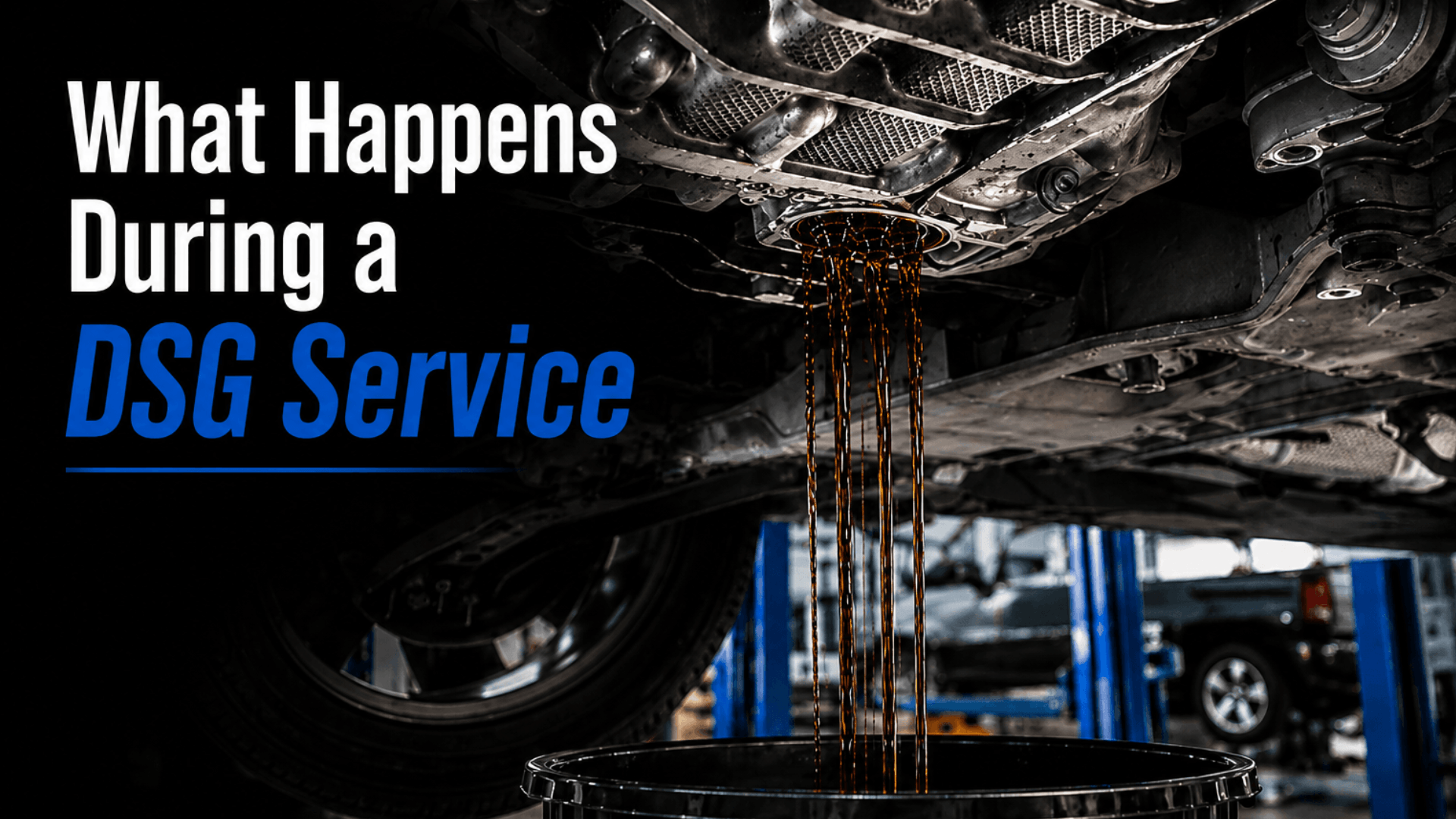
Fluid Drain and Inspection
On wet-clutch DSG systems, the transmission sump plug is removed and the fluid is drained.
The condition of the old fluid can provide valuable insight into gearbox health. In some cases the fluid may still appear relatively clean, while in others it may appear heavily discoloured with a burnt smell, particularly on tuned or heavily traffic-driven vehicles.
Filter Replacement
Some DSG variants use an external transmission filter.
While factory documentation on certain models may only specify replacement under particular conditions, we recommend replacing the filter during DSG servicing to maintain proper hydraulic flow to the mechatronic system.
A restricted filter can contribute to:
- Poor shift quality
- Hydraulic pressure irregularities
- Mechatronic performance issues
- Premature transmission wear
Temperature-Controlled Fluid Refill
Correct DSG fluid level is temperature-dependent.
The refill procedure is carried out while monitoring transmission temperature through diagnostic software to ensure the fluid level is set within the specified operating range.
Incorrect fluid levels can directly affect:
- Hydraulic pressure
- Clutch engagement
- Shift quality
- Internal lubrication
Adaptations and Basic Settings
Depending on the transmission type and operating condition, clutch adaptations and basic settings may also be checked or reset following servicing.
This allows the gearbox control unit to correctly recalibrate clutch engagement characteristics and maintain consistent shift quality.
Final Checks and Road Test
A final diagnostic scan is carried out to confirm no fault codes remain present. The vehicle is then road-tested through various operating conditions including:
- Cold start operation
- Low-speed driving
- Normal cruising
- Moderate acceleration
This verifies gearbox operation and confirms shift quality across the full operating range.
Common DSG Problems We See in the Workshop
Clutch Shudder at Low Speed
One of the most common DSG complaints is low-speed clutch shudder.
This usually feels like a vibration or slight judder during take-off or while driving between approximately 15–40 km/h under light throttle.
In some cases, degraded DSG fluid contributes significantly to the issue, and a properly completed service combined with adaptation resets can noticeably improve operation. If servicing has been delayed for too long, clutch wear may progress beyond what servicing alone can resolve.
Harsh Shifting Under Load
Some DSG transmissions shift normally during gentle driving but become noticeably harsh or aggressive under moderate to heavy acceleration.
This can indicate:
- Hydraulic pressure irregularities
- Solenoid wear
- Adaptation issues
- TCU calibration limitations on tuned vehicles
Increased engine torque without appropriate TCU calibration can place additional strain on clutch operation and shift control.
Fluid Contamination
We occasionally see DSG fluid contamination caused by:
- Water ingress
- Flood exposure
- Faulty transmission oil coolers
Once contaminated, the fluid rapidly loses its lubricating and hydraulic properties, which can quickly affect transmission performance and reliability.
DSG Servicing for Performance and Tuned Vehicles
Performance-tuned vehicles place significantly more demand on DSG transmissions. A Stage 1 tuned Golf R already exceeds factory torque targets for many DSG variants. Moving to Stage 2 or larger turbo setups increases thermal and clutch load even further.
This additional torque creates:
- Increased clutch heat
- Faster fluid degradation
- Higher hydraulic demands
- Greater clutch slip potential
Without properly matched TCU tuning, the transmission may still attempt to operate using factory pressure settings despite increased engine torque.
At Premier Autotune, we commonly recommend pairing ECU tuning with TCU tuning on DSG-equipped performance vehicles. This allows the transmission to better manage increased torque output while improving overall drivability and shift performance.
We frequently see tuned vehicles with healthy engines but heavily degraded DSG fluid well before factory service intervals suggest servicing is due.
For tuned vehicles, more frequent DSG servicing is strongly recommended.
The transmission should never be treated as a separate component from the overall performance system.
Frequently Asked Questions
For most wet-clutch DSG systems found in vehicles such as the Golf R, Audi S3, and Audi RS3, servicing every 45,000 to 60,000 kilometres is generally recommended under normal driving conditions.
Yes. Over time, degraded transmission fluid loses its ability to properly lubricate and maintain hydraulic pressure. This increases wear on clutch packs, solenoids, and mechatronic components.
Yes, significantly.
DSG and S-Tronic systems use a dual-clutch transmission design combined with a mechatronic control unit and require:
- Specific fluid specifications
- Temperature-controlled filling procedures
- Diagnostic calibration procedures
- Adaptation checks
These systems require specialised knowledge and equipment to service correctly.
Volkswagen & Audi DSG Specialist – Gold Coast
Premier Autotune specialises in Volkswagen, Audi, Skoda, Cupra, Porsche and other European vehicle servicing on the Gold Coast.
Our workshop provides:
- DSG & S-Tronic servicing
- ECU & TCU tuning
- Dealer-level diagnostics
- Coding & programming
- ADAS calibration
- Advanced fault diagnosis
- European vehicle servicing & repairs
Whether your vehicle is factory standard or performance tuned, maintaining the DSG correctly is critical for long-term reliability and drivability.
If you are noticing harsh shifting, clutch shudder, delayed engagement, or simply want preventative DSG servicing carried out correctly, contact Premier Autotune today.