
-
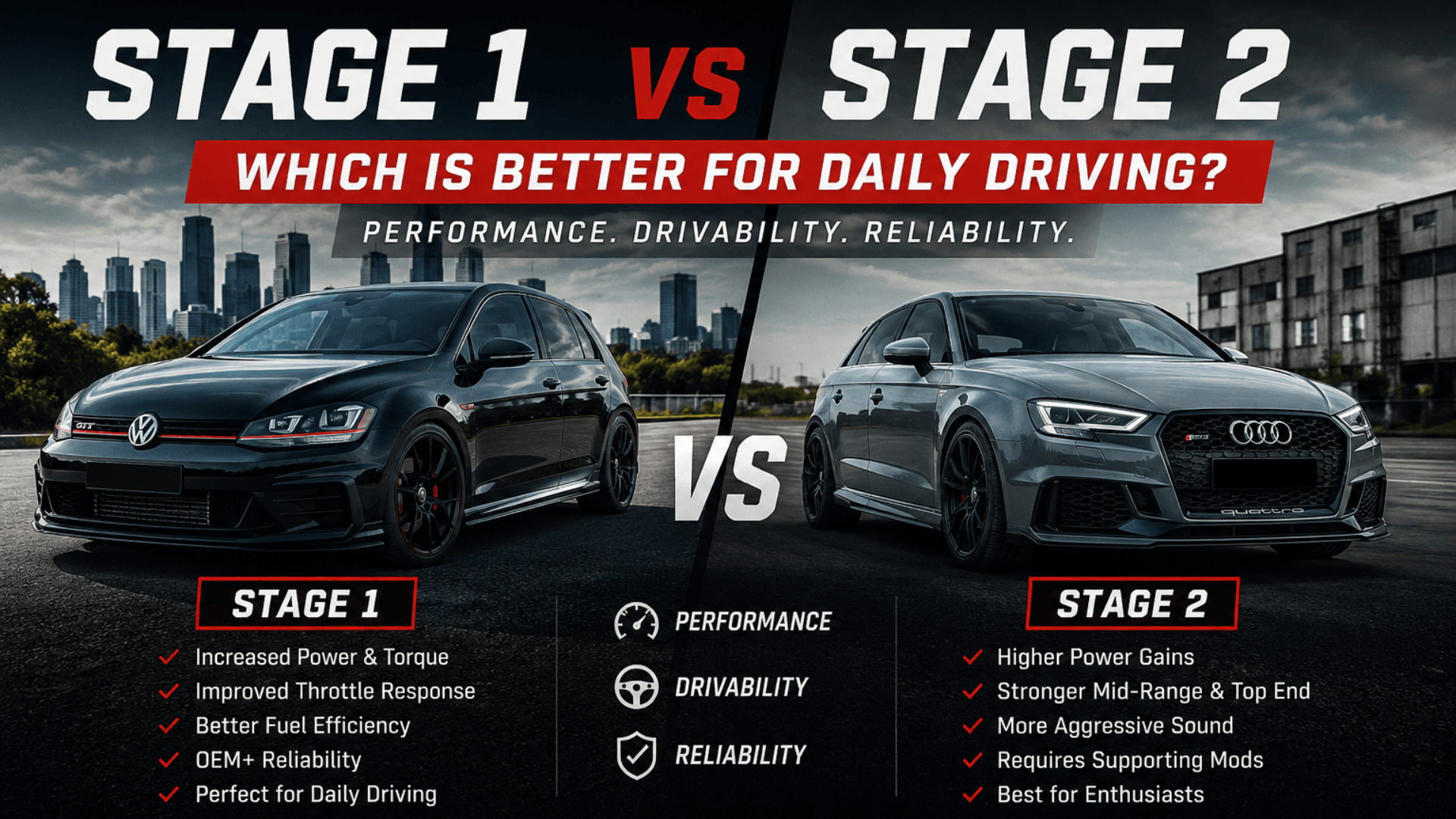
Stage 1 vs Stage 2 Tuning: Which Is Best? Premier Autotune
Stage 1 vs Stage 2 Tuning – Which Setup Is Best for Daily Driving?
For many Volkswagen, Audi, Porsche, and Skoda owners, the tuning conversation usually begins long before the vehicle arrives at the workshop. Most enthusiasts already know the terms Stage 1 and Stage 2. The real question is not which setup produces the bigger dyno number, but which one actually works best for how the vehicle is driven every day.
On paper, both options can sound appealing. Modern turbocharged VAG platforms respond extremely well to tuning, and the performance gains available from even relatively simple software calibrations are hard to ignore.
However, for a daily-driven vehicle, the better setup is not always the most aggressive one. What matters more is:
- How the vehicle behaves in real-world driving
- Long-term reliability
- Transmission behaviour
- Heat management
- Overall drivability after months or years of ownership
Some owners simply want sharper throttle response and stronger acceleration while retaining factory-like comfort and refinement. Others are prepared to accept increased noise, additional maintenance, and a more aggressive driving experience in exchange for higher performance output.
Both Stage 1 and Stage 2 tuning have their place. The key is choosing the setup that actually suits how the vehicle will be used.
What Is Stage 1 Tuning?
Stage 1 tuning is an ECU software recalibration designed to optimise the factory engine calibration without requiring major hardware modifications.
The tune typically adjusts:
- Boost pressure
- Ignition timing
- Fuel delivery
- Torque management
- Throttle response
- Turbocharger behaviour
On most vehicles, the factory intake, intercooler, exhaust system, and fuel system remain unchanged.
A properly calibrated Stage 1 tune works within the capability of the factory hardware rather than pushing components beyond their intended operating range.
On turbocharged Volkswagen and Audi platforms, the performance increase is usually very noticeable.
Engines such as the EA888 found in the Golf GTI, Golf R, Audi S3, and Audi TTS — along with the five-cylinder engines used in the Audi RS3 and TT RS — all have a significant amount of untapped performance from factory.
With a quality 98-octane calibration, Stage 1 tuning typically delivers:
- Stronger mid-range torque
- Faster throttle response
- Improved acceleration
- Sharper overall drivability
For most owners, this is what makes Stage 1 such an effective daily-driving setup. The vehicle still behaves very close to factory during:
- Cold starts
- Traffic driving
- Long highway trips
- Low-speed operation
Fuel economy during normal cruising can also remain surprisingly similar to stock while drivability improves significantly across the rev range.
For DSG and S-Tronic vehicles, pairing ECU tuning with TCU tuning is also important. The gearbox calibration can then be adjusted to properly suit the increased torque output, improving:
- Shift response
- Clutch pressure control
- Torque management
- Overall transmission behaviour
Many owners are surprised by how much stronger the vehicle feels without sacrificing day-to-day comfort.
What Is Stage 2 Tuning?
Stage 2 tuning builds on the ECU calibration by adding supporting hardware upgrades that allow the engine to produce more power efficiently and consistently.
Common Stage 2 modifications on VAG vehicles include:
- High-flow or performance downpipes
- Upgraded intercoolers
- Turbo inlet upgrades
- Performance intake systems
- Fuel system upgrades on some platforms
The ECU calibration is then specifically developed around that hardware combination. Compared to Stage 1, Stage 2 generally delivers:
- Higher torque output
- Stronger top-end performance
- Improved sustained power under load
- Better airflow efficiency
The vehicle can typically maintain performance more consistently during repeated acceleration and aggressive driving conditions.
However, Stage 2 also changes the character of the vehicle more noticeably.
Cold starts are usually louder, particularly on vehicles fitted with aftermarket downpipes. Exhaust volume increases under acceleration, and drivetrain components operate under greater load.
For some owners, this creates a more exciting and engaging driving experience.
For others, the increased noise and more aggressive behaviour eventually become less practical for everyday driving.
In the workshop, we regularly see owners initially move straight to Stage 2 chasing larger power figures, only to later realise they preferred the quieter and more refined feel of a well-calibrated Stage 1 setup for daily use.
The overall cost difference also becomes significant once supporting hardware, installation, maintenance, and transmission servicing are factored in.
Fuel Quality Matters
Fuel quality plays a major role in tuning performance and long-term reliability.
Most modern Volkswagen and Audi performance calibrations are designed around 98-octane premium fuel to maintain:
- Ignition stability
- Knock control
- Consistent power delivery
- Safe combustion temperatures
Lower fuel quality can reduce performance consistency and increase engine correction activity under load.
This becomes increasingly important on higher-output Stage 2 setups where thermal and cylinder pressure demands are higher.
How Stage 1 and Stage 2 Feel in Daily Driving
This is usually where the real decision gets made.
Cold Starts and Noise
Stage 1 vehicles generally retain near-factory refinement.
Cold starts, idle quality, and highway cruising remain very close to stock while still delivering noticeably improved performance under acceleration.
Stage 2 vehicles fitted with aftermarket downpipes are significantly louder during cold starts and under load. Depending on the setup, this can become more noticeable during early morning starts or in residential areas.
Traffic and Stop-Start Driving
Stage 1 setups usually remain very smooth and factory-like in traffic conditions.
Stage 2 vehicles, particularly those running aggressive TCU calibrations, can sometimes feel slightly less refined during slow-speed crawling or repeated stop-start driving.
Fuel Consumption
Under normal highway driving, Stage 1 fuel consumption can remain surprisingly close to factory figures.
The engine often operates more efficiently under light load due to improved torque delivery.
Stage 2 follows the same principle, although fuel consumption increases more noticeably under heavy acceleration due to the higher overall power output.
Heat Management in Australian Conditions
Queensland temperatures place additional stress on tuned vehicles, particularly during summer. This is especially noticeable on EA888-powered platforms such as the Golf R and Audi S3, where intake air temperatures can rise quickly during repeated acceleration or extended hard driving.
A properly engineered intercooler upgrade on a Stage 2 vehicle can significantly improve consistency under sustained load.
However, poorly designed or incorrectly sized cooling upgrades can sometimes reduce consistency rather than improve it.
Once power levels increase, even small cooling system weaknesses become more noticeable. Before tuning higher-output vehicles, we regularly inspect:
- Radiator condition
- Cooling fan operation
- Coolant system performance
- Existing fault codes
- Overall engine health
Large advertised power figures mean very little if cooling performance, drivability, or long-term reliability are compromised.
Long-Distance Comfort
Stage 1 tuning generally preserves the comfortable touring nature of the vehicle.
For owners regularly driving long highway distances, this often becomes a major advantage.
Stage 2 setups with:
- Louder exhaust systems
- Firmer suspension
- Aggressive transmission calibration
can become more demanding during longer drives.
For some owners this is perfectly acceptable. For others, the novelty eventually wears off during daily commuting.
DSG and Transmission Considerations
The transmission is one of the most overlooked parts of the tuning conversation. Most modern VAG performance vehicles use DSG or S-Tronic gearboxes such as:
- DQ250
- DQ381
- DQ500
These transmissions handle increased power extremely well when properly maintained. However, higher torque levels place additional stress on:
- Clutch packs
- Hydraulic systems
- Mechatronic components
- Transmission fluid
For tuned vehicles, DSG servicing intervals should generally be shortened.
Early signs of neglected DSG maintenance often include:
- Clutch shudder at low speed
- Delayed engagement
- Harsh shifting under load
- Hesitation during acceleration
Addressing these issues early through servicing and adaptation resets is significantly more cost-effective than allowing wear to progress further.
TCU tuning also becomes increasingly important at higher power levels.
The gearbox calibration should properly match the engine torque output to maintain:
- Correct clutch pressure
- Smooth torque delivery
- Shift consistency
- Long-term drivability
Reliability – Stage 1 vs Stage 2
A properly calibrated Stage 1 tune on a healthy vehicle is generally very reliable.
The calibration remains within the capability of the factory hardware while improving performance and drivability without dramatically changing the vehicle’s operating characteristics.
Stage 2 can also remain reliable when supported with:
- Proper hardware upgrades
- Quality tuning
- Correct cooling performance
- Consistent servicing
- Suitable fuel quality
Reliability is usually determined less by the tuning stage itself and more by:
- The quality of the calibration
- The condition of the vehicle beforehand
- Cooling system health
- Oil quality
- Transmission servicing
- Ongoing maintenance
Poorly maintained vehicles often develop problems after tuning simply because existing weaknesses become more noticeable once performance increases.
Which Setup Is Better for Daily Driving?
For most owners who use their vehicle every day, Stage 1 generally offers the best overall balance.
It improves:
- Throttle response
- Mid-range torque
- Acceleration
- Overall drivability
while still preserving the comfort, refinement, and practicality that make the vehicle enjoyable to live with long term.
Stage 2 is better suited to owners who specifically want the additional performance and understand the increased maintenance, noise, and drivetrain demands that come with it.
Many Golf R, Audi S3, and RS3 owners ultimately find Stage 1 to be the setup they enjoy most consistently over time.
It delivers a substantial improvement in performance without fundamentally changing the character of the vehicle.
Stage 2 usually makes more sense for owners who genuinely plan to use the extra performance rather than simply chasing larger numbers online.
Why Platform Knowledge Matters
Tuning VAG vehicles properly requires platform-specific knowledge and diagnostics experience. The EA888 engine behaves differently from Audi’s five-cylinder platforms. DSG calibration strategies vary between DQ250, DQ381, and DQ500 transmissions.
Cooling requirements also differ significantly between vehicles such as:
- Golf R
- Audi RS3
- Porsche Macan
- Porsche Cayenne
even where shared engineering principles exist.
Correct diagnostics, software calibration, transmission adaptation procedures, and supporting hardware selection all influence how successful the final result feels in real-world driving.
Making the Right Choice
For most daily-driven Volkswagen, Audi, Porsche, and Skoda vehicles, Stage 1 remains the more balanced long-term setup.
It sharpens the driving experience while maintaining the comfort, refinement, and reliability most owners still expect from a modern European vehicle.
Stage 2 suits owners who genuinely want a more aggressive setup and are prepared for the additional maintenance, drivetrain load, and overall changes in vehicle behaviour.
Whichever route is chosen, ongoing maintenance remains the foundation of a reliable tuned vehicle.
DSG servicing, oil quality, cooling system health, spark plugs, diagnostics, and transmission calibration all become increasingly important once performance levels rise.
At Premier Autotune, tuning is approached as part of the complete vehicle system rather than simply chasing peak dyno figures.
ECU calibration, DSG behaviour, cooling performance, servicing history, and drivetrain condition all play a role in how the vehicle performs long term.
Frequently Asked Questions
Yes — when completed properly on a healthy vehicle, Stage 1 tuning is generally very reliable for daily driving. The calibration remains within the capability of the factory hardware while significantly improving drivability and performance.
Not necessarily. When supported with suitable hardware, proper cooling performance, and disciplined maintenance, Stage 2 can still remain reliable. However, it does place greater demand on the drivetrain, transmission, and cooling systems.
Yes. Tuned DSG and S-Tronic vehicles should generally have shorter fluid and filter servicing intervals compared to stock vehicles, particularly at higher torque levels.
On DSG-equipped vehicles, TCU tuning is strongly recommended. It allows the gearbox calibration to properly match the engine’s increased torque output while improving shift behaviour and clutch control.
Vehicles such as the Golf GTI, Golf R, Audi S3, Audi RS3, and TT RS are among the strongest Stage 1 platforms due to the substantial performance headroom built into their factory turbocharged engines.
Porsche Macan and Cayenne models using turbocharged VAG-derived engines also respond extremely well to tuning.