
-
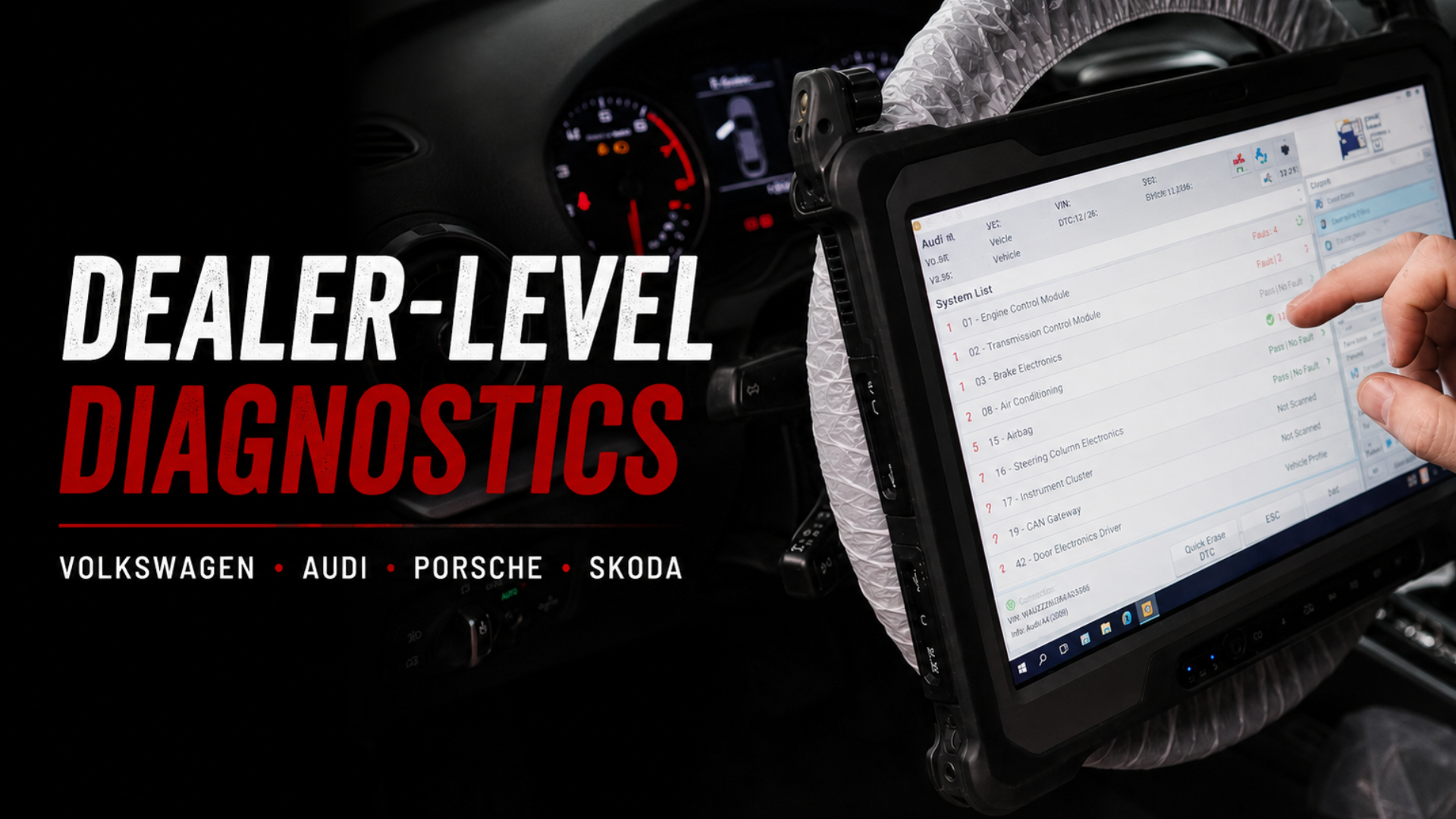
Dealer-Level VAG Diagnostics Premier Autotune
Dealer-Level Diagnostics for Volkswagen & Audi Vehicles
Modern Volkswagen, Audi, Porsche, Skoda, and Cupra vehicles are far more advanced than many owners realise. A warning light on the dashboard is no longer always caused by a simple mechanical issue. Modern VAG vehicles rely on dozens of interconnected control modules constantly communicating across complex electronic networks throughout the vehicle.
Systems such as the engine management, DSG or S-Tronic transmission, adaptive suspension, steering, air conditioning, infotainment, driver assistance systems, radar sensors, cameras, and battery management all depend heavily on software integration and electronic communication.
As these vehicles become more advanced, proper diagnostics become far more important than simply plugging in a generic scan tool and clearing fault codes.
At Premier Autotune , dealer-level diagnostics refers to using professional VAG diagnostic systems, factory repair information, and platform-specific experience to properly diagnose, repair, code, calibrate, and program modern European vehicles. For many owners, this becomes important after another workshop has already attempted repairs without successfully identifying the root cause of the issue.
Modern European Vehicles Are Software-Driven
Vehicles such as the Volkswagen Golf R, Audi RS3, Porsche Macan, and newer Cupra models rely heavily on software communication between multiple control modules. A fault within one system can sometimes create symptoms in another completely different area of the vehicle.
A weak battery may trigger multiple communication faults. Incorrect coding can disable certain vehicle functions. Software compatibility issues may affect transmission behaviour, drivability, or warning systems. Even relatively minor faults can quickly become difficult to diagnose without the correct equipment and platform knowledge.
That is why modern diagnostics involves much more than simply reading a fault code description.
Why Generic Scan Tools Often Miss the Real Problem
One of the most common situations we see in the workshop is a vehicle arriving after multiple parts have already been replaced elsewhere without resolving the problem.
Generic scan tools can often read basic fault codes and clear warning lights, but they usually cannot access the full range of manufacturer-specific functions required on modern Volkswagen and Audi platforms.
On many vehicles, fault codes are only the starting point of the diagnostic process. Proper diagnosis may involve monitoring live boost pressure data, analysing fuel pressure behaviour, checking DSG clutch adaptation values, verifying communication faults between modules, testing wiring integrity, and performing guided manufacturer test procedures.
Without the correct equipment and software capability, it becomes very easy to misdiagnose expensive components or overlook the actual cause of the fault altogether.
Access to Factory Repair Information Matters
Modern Volkswagen, Audi, Porsche, Skoda, and Cupra vehicles rely heavily on manufacturer repair procedures, software integration, and platform-specific technical documentation.
At Premier Autotune , we have access to factory VAG repair information systems and online manufacturer resources used for advanced diagnostics, coding, programming, and repair procedures across modern European vehicles.
This includes access to factory wiring diagrams, official repair manuals, guided fault-finding procedures, technical service information, spare parts catalogues, software and coding documentation, DSG and S-Tronic repair procedures, factory calibration instructions, torque specifications, and online programming functions.
Modern diagnostics often involves far more than simply reading a fault code. Accurately diagnosing modern VAG vehicles may require tracing communication faults across multiple modules, monitoring live data, verifying software compatibility, checking wiring integrity, and following manufacturer repair procedures specific to the exact platform and build configuration.
Having access to correct factory repair information helps ensure repairs and diagnostics are carried out properly rather than relying on guesswork or generic aftermarket information.
What Dealer-Level Diagnostics Actually Involves
Dealer-level diagnostics means using professional VAG diagnostic systems capable of communicating with the vehicle similarly to factory dealership systems.
This allows access to advanced functions such as coding and programming, adaptation procedures, guided fault-finding, online software services, calibration functions, software version management, and component protection handling.
At Premier Autotune, diagnostics often involves far more than simply scanning fault codes. Depending on the issue, the process may involve monitoring live sensor data, checking software compatibility, analysing transmission adaptation behaviour, reviewing battery management history, performing calibration procedures, and running guided factory test plans.
This level of diagnostics becomes increasingly important on modern European vehicles where software integration now plays a major role in overall vehicle operation.
What Is Component Protection?
One area many independent workshops struggle with is component protection.
Modern Volkswagen and Audi vehicles use electronic security systems designed to prevent certain modules from functioning correctly if they are replaced without proper authorisation and programming.
If component protection is active, replacement modules may partially function, display warning messages, lose certain features, or fail to communicate correctly with other systems in the vehicle.
Correctly handling component protection requires specialist VAG diagnostic capability and platform-specific knowledge.
Coding and Programming Matters More Than Ever
Many modern European vehicle repairs now involve some level of coding, calibration, or software configuration.
Even relatively routine repairs may require battery coding, steering angle calibration , DSG adaptations, injector coding, radar alignment, software parameter resets, module programming, or camera calibration procedures.
Without the correct coding and programming procedures, vehicles can display warning lights, develop communication faults, lose functionality within certain systems, or operate incorrectly.
This is becoming increasingly common across newer Volkswagen, Audi, Porsche, and Cupra platforms as electronic integration becomes more advanced.
Diagnostics Before Replacing Parts
Accurate diagnostics should always happen before replacing components.
We regularly see vehicles where sensors were replaced unnecessarily, modules were changed without coding, software-related faults were mistaken for hardware failures, or wiring issues were completely overlooked.
Modern European vehicles require a structured diagnostic process. Replacing parts purely based on fault code descriptions can quickly become expensive without actually resolving the underlying issue.
Diagnostics Become Even More Important on Tuned Vehicles
On tuned Volkswagen and Audi platforms, diagnostics becomes even more important.
Proper diagnostics may involve monitoring ignition correction values, checking fuel pressure stability, analysing intake air temperatures, verifying boost control behaviour, checking DSG clutch operation, and reviewing compatibility between ECU and TCU software systems.
A properly calibrated tuned vehicle should still operate smoothly, consistently, and predictably during everyday driving conditions. When drivability issues appear, correct diagnostics becomes essential before assumptions are made about the tune itself.
Dealer-Level Diagnostics vs Generic Fault Code Scanning
There is a major difference between simply reading a fault code and properly diagnosing the vehicle.
For example, a generic scan tool may display a boost pressure regulation fault. Proper diagnostics may reveal the actual cause is a boost leak, diverter valve issue, wastegate operation problem, sensor plausibility fault, wiring issue, software adaptation problem, or incorrect boost control behaviour.
The fault code itself is often only the symptom rather than the actual cause of the problem.
That distinction is what proper diagnostics is designed to identify.
Why Platform-Specific Knowledge Matters
Volkswagen Group vehicles all share engineering similarities, but each platform behaves differently.
An EA888-powered Golf R behaves differently from an Audi RS3 2.5T platform or a Porsche Macan. Transmission behaviour, thermal management, software strategies, and module integration can vary significantly between different VAG platforms.
That is why platform-specific knowledge matters just as much as the diagnostic equipment itself.
Volkswagen & Audi Diagnostics Specialist – Gold Coast
At Premier Autotune, diagnostics is approached as a complete process rather than simply reading fault codes and replacing parts.
Our workshop specialises in dealer-level VAG diagnostics, DSG and S-Tronic diagnostics , coding and programming, component protection handling, ECU and TCU diagnostics, ADAS calibration, software configuration, and European vehicle servicing and repairs.
Frequently Asked Questions
Dealer-level diagnostics refers to using professional manufacturer-capable diagnostic systems specifically designed for Volkswagen Group vehicles. This allows access to advanced functions such as coding, programming, guided fault-finding, calibration procedures, adaptations, and live manufacturer-specific data.
Generic scan tools can often read basic fault codes, but they usually cannot access all control modules or perform advanced functions required for accurate diagnosis on modern VAG platforms.
Component protection is a factory security system designed to prevent certain modules from functioning correctly if they are replaced without proper authorisation and programming.
Pre-tune diagnostics confirms the vehicle is mechanically and electronically healthy before performance increases are introduced. Existing faults, boost leaks, cooling issues, or transmission problems should always be identified before tuning begins.
Modern European vehicles rely heavily on interconnected software systems, coding, module communication, and electronic integration. Proper diagnosis often requires manufacturer-level equipment, factory repair information, programming capability, and platform-specific experience.